Monday, October 21, 2019

How to Get to Nashville on the Tennessee River


Our white Looper flag. 
Loopers are members of the America’s Great Loop Cruisers’ Association (AGLCA) and quickly identified by the burgee on their boat bow, white for first timers, gold for 2nd timers and platinum for 3rd timers.  We are all sharing the same 6,000+ mile journey even if on different starting points, schedules and side trips.  Some boats we will see only once, if at all, others every now and then and a few for a more extended period of time.
Last picture, for now, with Jay and Barb.


In this environment friendships between boaters start quickly, often end just as abruptly and a few may last a life-time, which is what we expect for Jay and Barb Morrow, who hail from Winnipeg.  We briefly met them and their boat, The Blessing, in the Illinois River.  We then cruised together down the Mississippi, up the Ohio, and then over 200 miles up the Tennessee River where we shared multiple stops, experiences, conversations and meals and we guess, more than a few beers.  Together
Molly's birthday celebration in
Paducah.  Jay took the photo.
we celebrated Molly’s birthday and finally the bittersweet celebration of their   completion of the Loop.  Jay and Barb are now on their way home, their boat for sale at Aqua Marina in Iuka, MS, and they are contemplating the next chapter of their lives. 
Jay and Barb are holding their just
earned Gold Burgee for completing
the Great Loop.
We hope it includes a trip to Maine next summer.
Our boat, Salty Paws, in one of the
Tennessee River locks.

We left Paducah and the Ohio River on 10/3 in a 5-boat group flotilla led by The Blessing to head up the Tennessee River to the Kentucky Lake Lock.  The mid-America confluence of rivers (Mississippi, Missouri, Ohio, Cumberland, Tennessee, Illinois and others) is a unique waterway system that has fostered movement of people and goods for centuries.  The water levels have also regularly fluctuated over 40 feet due to spring runoff, storms and drought.  The Great Depression led to efforts to better tame these waters and improve the economy.  One effort was the creation of the Tennessee Valley Authority (TVA) in 1933 to provide electrical power and flood control on the Cumberland and Tennessee watersheds.  The TVA’s first major project was building Kentucky Dam and Lock (completed 1944) at mile 25 of the Tennessee River.  The dam raised water levels 50 feet and flooded over 100 miles, creating Kentucky Lake, the largest manmade lake in the east.  The flooding displaced whole towns and hundreds of rural families and flooded historical sites such as the Civil War’s Fort Henry. 
In this LBL cove we were able to walk
 right off our boat on to the shore.  We
were able to quickly find the nearby trail.
This old sign reads "WBTS Cemetery."
This family plot in the LBL had only
three markers, all with a date of death
in the 1930s.  Did they die, perhaps,
because they were being forced to move?
The land between Kentucky Lake and Barkley Lake, a similar manmade lake on the Cumberland River is called the Land Between the Lakes (LBL).  It was made a national recreational area in the 1960s.  We much enjoyed anchoring in secluded coves of LBL and hiking some of the trail system to find a few old family cemeteries, house foundations and other remnants of a different era.  One of the highlights was finding the Civil War Cemetery of the five confederate Fort Henry soldiers who died when their cannon exploded while being attacked by Union forces.  We also found the old State highway sign that reads “WBTS Cemetery.  WBTS stands for “War Between the States,” and we learned in our 2016-17 boat trip that this was the common name for the war among Southerners as they didn’t want to promote the view that we were one country.

Periodically in towns along the Tennessee River we have seen signs reading the “Trail of Tears,” identifying one of the saddest chapters in American history.  16,000 Cherokees were forced from their homes in the east and marched or boated to Oklahoma.  Roughly 4,000 died on the journey that took up to a year to complete.  We learned more about this event in our visit to the Tennessee River Museum in Savannah, TN.  This town is also home to the Cherry Mansion, which served as Grant’s Civil War headquarters in the nearby bloody battle at Shiloh.  We got to talk with the present occupant of the Mansion, who owns a local gift shop. 

Morning 
From the beginning of our trip we have wanted to go to Nashville, which is on the Cumberland River, not the Tennessee.  We were also interested in going to Chattanooga, but we don’t have enough time to go up both rivers.  Other Loopers suggested that we travel up the Tennessee to Chattanooga and then rent a car to go to Nashville.  That way, we are able to visit both cities and cruise on the much more interesting Tennessee.  This river did not disappoint.  After the LBL, we continued another 300 or so miles through 5 more locks, each one followed by yet another beautiful man-made lake.  We anchored out every night except for one free municipal dock.  We saw few boats and were alone in our travels as most Loopers were attending the Fall Rendezvous at Joe Wheeler Park on the Tennessee.  We attended the opening night docktails, but then continued on our travels as the Rendezvous was fully booked at the time we finalized our Chattanooga plans.
Nickajack Lake.

One of many great views in the Canyon.
We enjoyed our happy hour on the roof of Salty Paws.
Once through the last lock we entered Nickajack Lake, with low mountains on both sides.  Using a trail app we identified a hike on a nearby peak and found a place to anchor to go ashore for a very pleasant 3-mile hike on Little Cedar Mountain.    

After the hike, we motored a few more miles and anchored for the night surrounded by canyon walls.  This was a special spot augmented by the fall colors (although much more muted than in Maine).  The next day we awoke to a beautiful foggy sunrise as the water temperatures are still over 70 but the air temperature was in the 40s.  Chattanooga was just another 20 miles upriver through the spectacular river gorge.  
  
Approaching Little Cedar Mountain for our hike.
Chattanooga is a nice, small city filled with restaurants and artwork, a great aquarium and nearby Ruby Falls and Rock City on famous Lookout Mountain.   We docked right in the heart of the city and enjoyed an afternoon and evening exploring and eating.  The next day (10/19) daughter Liz, her husband Matt and our one precious granddaughter Charlotte picked us up for the 2-hour drive to Nashville where we had been able to book two of the last rooms available in the city.


The line at Martin's BBG Joint.
The Grand Ole Opry was a lot of fun.
The Opryland Hotel has a
river that goes around the
humongous inner courtyard.


Nashville is a fast-growing, dynamic city that is booming with construction, tourists and sports fans.  We walked down Broadway finding great live music in virtually every one of the many restaurants and bars.  And this was at 11:30 am.   We picked one and were not disappointed by the food or the talented singer guitarist playing many of our favorite tunes. 
On Broadway in Nashville.
That night brought us all to the Grand Ole Opry for their classic country show where stars are known to show up unannounced.  The week before Dolly Parton had surprised the crowd.  We were not as fortunate, but the musicians and singers were all very talented and put on a good show.   The next day our weekend was topped off with a visit to the Zoo and Martin’s Rib Joint, a Nashville classic stop, and the lines to get in proved it!


We are now back in Chattanooga and were quickly joined at the dock by 9 Looper boats that just arrived up the Tennessee.  Within minutes of the first boat docking, we were invited to drinks and dinner with out fellow Loopers at a nearby restaurant. . Also, Jerry and Jenny on Sweetgrass, the boat next to us, told us that they had cruised with the original owners of Salty Paws 8 years ago and having first met in Michigan had met again on this same dock in Chattanooga.  Crazy coincidence but highlights the tight community of this journey.  We will certainly reach out to the original owner.
to Mimi.  We will see everyone again next
month as we fly back to Maine from Atlanta
for Thanksgiving and the wedding!
Time for goodbyes to Grandpa and...


Tomorrow begins our trip back down the Tennessee to the Tenn-Tom Waterway at mile 208.  The Tenn-Tom is a system of canals and locks, primarily in Mississippi, that will bring us down to the Gulf at Mobile, 

Wednesday, October 2, 2019

History with a Maine Connection


We experienced the Arch by land and...

Anytime we travel, whether by boat or car, Molly and I always seem to be more conscious than we would be at home of the history around us.  The confluence of two mighty rivers, the Missouri and the Mississippi, is such a place.

by sea.  We traveled with two other
boats and took turns taking each
other's picture.
In 1803 the residents of St. Louis started the weekend as citizens of Spain, slept as citizens of France and woke up as citizens of the United States with the Louisiana Purchase.  We learned that overnight women lost the right to buy and sell property, and blacks lost the right to buy freedom from their masters.   The stage was also set for St. Louis to become the gateway to western expansion.  President Jefferson got Congress to agree to fund the Lewis and Clark expedition with the goal to explore and catalog the new lands, seek the Northwest Passage (that didn’t exist) and claim Oregon for the US.
The white line shows the Lewis and Clark Route while the darkened area is the Louisana Purchase.  Note that Oregon
was still unclaimed by any world power.  Of course, little thought was given to the Native Americans there and elsewhere.


Monument to Lewis and Clark at the
confluence of the Mississippi and the
Missouri Rivers.
Cohokia Indian Mound.
Along the Lewis and Clark trail there are over 50 museums commemorating their journey, and while in Alton, IL, we rented a car and visited three of them.  In our travels, we also stumbled on the Cahokia Mounts National Monument where a thousand years ago the Cahokia Indians built large earthen mounds of several acres and up to 4 levels raising 100 feet over the otherwise flat terrain.  The parking lot here was filled with school buses signifying, perhaps, the importance of exposing school children to one of the few examples in America of the existence and capabilities of Native Americans who lived at a time called here “prehistory.”

The expansion of the United States brought to the forefront the Slavery Question, would a new state be slave or free?   The Missouri Compromise of 1820 brought in Maine as a free state in 1820 and Missouri as a slave state in 1821.  Abolitionists and slave supporters began flocking west in hopes of influencing the future direction to slave or non-slave. 


Monument to Elijah Lovejoy in Alton, IL.
One such person was Elijah Lovejoy, born in Albion, Maine and came to Alton, IL as both a Presbyterian minister and newspaper publisher.  He preached in nearby St. Charles, MO, and was run out of town for his abolitionist views.  Three times his Alton printing presses were dumped in the Mississippi River following his antislavery commentaries, and on the fourth time this happened a mob killed him as he tried to protect his press. This happened in 1837, and Lovejoy has been called “the first casualty of the Civil War.”

We visited St. Louis, touring the impressive Anheuser-Busch Plant,  seeing the Cubs-Cards game at Busch Stadium and visiting the national park with the Arch and the nearby Old Courthouse.  The recently named The Arch National Park was very impressive, both at dusk and in the morning.  The Old Courthouse was the site of the Dred Scott case which petitioned the courts to allow his family freedom since they had lived for a time in a free state.  This famous case took a decade to pass through the courts until the US Supreme Court ruled in 1958 that the word “citizen” in our Constitution only referred to “whites.”  This further inflamed the tensions of the day, leading to the Civil War.
View of the Old Courthouse from the Arch.
We toured the Clydesdale stable at
the brewery.

Their were many Cubs
fans in town for the game.
They were greeted at
our hotel with this.


Depiction of St. Louis waterfront  in 1850.
 While touring Alton we visited the square and statues commemorating the last 1860 presidential debate between Lincoln and Douglas.  Lincoln had an antislavery platform (“A house divided cannot stand”) whereas Douglas promoted states’ rights to decide the question. While Douglas had defeated Lincoln in the 1858 US Senate race,  Douglas only carried two states in the 1860 presidential election, Missouri and New Jersey. 

Robert Wadlow was still growing
at the time of his death at age 22.
Another local landmark was the 8’ 11” life-sized statue of Robert Wadlow, the world’s tallest man.  He was born and lived in Alton and died at the age of 22 from an untreated infection.  He was still growing at the time of his death.  Finally, we could not depart Alton without eating twice at the very popular Fast Eddies, where $3 will get you a half pound burger and fries. 

At Fast Eddies with Looper friends Jay and Barb Morrow.


This institution was started by Anheuser-Busch before breweries were prohibited from operating restaurants and retail establishments.  The restaurant was sold in 1931 during Prohibition, and has been owned by only 2 families since then.

We were in a covered slip for the first time at Alton Marina.
While at the Alton Marina for four nights, we met and/or reacquainted ourselves with fellow Loopers, often over docktails by the pool.  Early on September 29th we departed with two other boats to make the 200-mile trip down the Mississippi to the Ohio and then 50 miles up to Paducah, KY, the next available gas stop.  Fortunately, the 5-6 mph current in the Mississippi helped ensure that we would arrive with gas to spare.

We are now into our 4th consecutive day of 90+ degree temperatures.  Fortunately, Paducah
Just one of many outstanding displays at the
 National Quilt Museum.
 is a wonderful town with many restaurants and shops along with the National Quilt Museum and Hancock's of Paducah.  October 2nd was Molly's birthday, and we celebrated with visits to the Museum and Hancock's.  The Museum was unbelievable.
Molly was overjoyed to be at
Hancock's of Perducah to
purchase her birthday present.


This was one of the fascinating
quilts at the Museum as the face
can only be seen in small images
and is best viewed through
a camera lens.

At the Paducah dock.  We are the 2nd boat from the left and
most always the smallest boat around.


Saturday, September 28, 2019

Illinois River, Locks and... its the little things

We were the only boat on the Chicago River.
Bill and I left Chicago on 9/15 after an amazing few days in this glorious city.  So I humbly confess that I have been an ocean snob.  Wrong!  Chicago is laid out along Lake Michigan, and the Lake and Chicago River are integral to life here in this “inland” Midwestern City.  Thousands of boats line the waterfront, sailboat races are almost nightly, and the waterfront parks attract walkers, runners and bikers.  We leave the Great Lakes with so much respect and admiration.
A fellow Looper captured our boat
on the Illinois River.

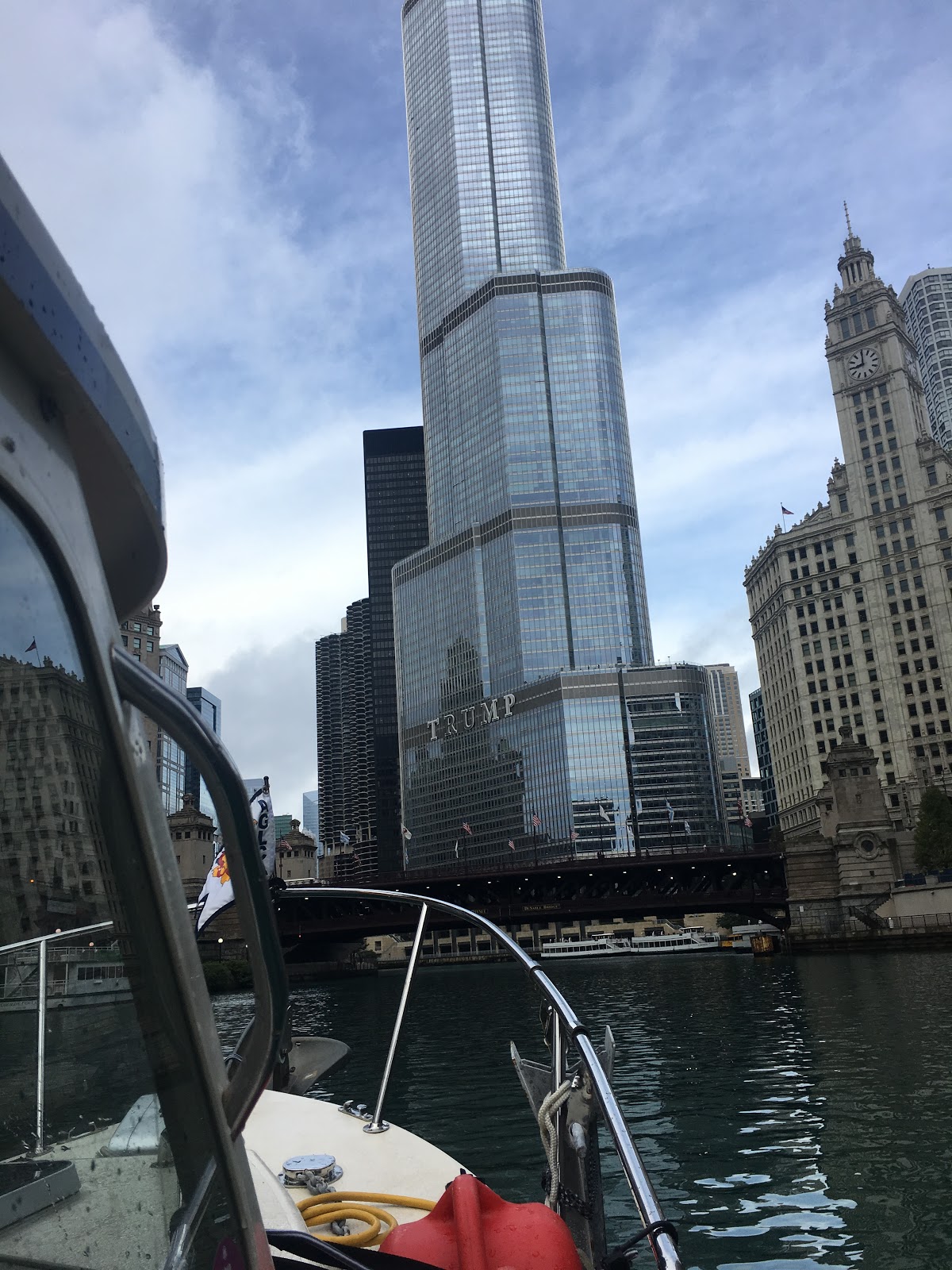
So we set out early on a foggy Sunday morning and for ten or so minutes, faced the wildest waters we have yet seen on this trip. We safely made it through the Chicago lock and the entrance to the Chicago River which took us right through downtown, under 18 bridges, past historic buildings and glittering sky scrapers. The fog finally lifted as we passed the Sears (Willis) Tower.

There is a section of the Illinois River electrified to keep
Asian Carp out of the Great Lakes.  
As the skyscrapers fade away, huge industrial facilities begin to come into view in notable contrast. The river is no longer green blue, but is now a dark, opaque brown.  It is known as the Illinois Waterway with several named rivers before becoming the Illinois River.  We have 5 locks to get through before the locks close for two weeks for repairs.  Many fellow loopers are in the same race.  We are in communication with these boats by VHF radio and with an app called NEBO.  We have this last race to run before we can finally slow down and not be in a rush.  We got through the Lockport Lock, the first of these 5 locks,  and then spent the night rafted to another Looper boat against the Joliet wall. The wall has a capacity of only 12 or so boats, but we are doubled up since no recreational boats were allowed through the locks today.  Getting through the next four locks is now a challenge, as we are competing with river barges which are also trying to beat the lock closures.

Thus was the view from our roof of our Looper caravan
of boats in the Brandon Lock on the Illinois River.

The next morning, 2 of the Looper boat captains have taken charge of this caravan. They are in communication with the lockmasters and with each of us and are organizing how we can fit efficiently into these 600’ x100’ locks, the first one being Brandon Lock.  We have a green light for a 6:30 am departure.  Kudos to these two captains, as they calmly repeated instructions multiple times to these sometimes nervous pleasure boat captains. Our little boat was called to the front of the pack. Ultimately, about 28 boats fit in beautifully, rafted together in rows of 5 or 6 boats. This whole process took about 3 hours. Then on to Dresden Lock.  We got to the dam and had to wait on anchor for an hour or two to be called for passage. This time, the lockmaster only allowed 12 boats in, leaving the remainder of the boats to wait another few hours for the next opening.  We went through in the first group because our small boat allowed us to be right down front in the lock.

We didn't take this picture of Asian Carp, but I wanted to give
you an idea of what these fish can do,.
That day we made it through 1 more lock, Marseilles Lock, with Bill being the 12-boat convoy contact with the lockmaster.  We  finally tied up at the town dock in Ottawa, Illinois.  We had done 3 locks and 48 miles in 11 hours.  Coming into this dock, we turned up into a rapid current of a small river dumping into the Illinois.  As we are coming in, and I am outside the boat preparing the lines, I hear something huge fall off the top of the boat.  As I am trying to figure out what fell, I then see a huge fish leaping about 8’out of the water next to our boat. Maybe I screamed? Anyway, we get tied up to this rickety dock with the help of the couple already tied and he explains that we have seen an Asian carp, an invasive species that is a terrible nuisance in the Illinois. Look this up on YouTube and you will understand why I might have screamed.  Apparently they were stirred up by our outboard motor, and it is not uncommon for these fish to jump into boats.
The lower half of the Illinois River is serene and sparsely populated.

The next morning, we get through the last of the 5, Starved Rock Lock, with little difficulty.  We immediately turn on our 10 hp motor and raise our big motor.  We had been speeding along so far to stay up with the pack. We can finally slow down, stop racing the clock, or the tricky waves on Lake Michigan, or the lock closures.  As a fellow Looper put it, we feel like we have broken out of prison. Now, everyone can pass us. Our focus on the Illinois had been getting through, and we had not been terribly focused on where we were or what we were seeing. This all now changed.
Here I am in the courtroom where
Lincoln (see painting) argued the
famous Almanac Trial.
Many houses in Hardin were
surrounded by sandbags but still
severely damaged by the flood.
Our eyes were now opened to our surroundings. We hadn’t gotten off our boat in our lock race. We now got off most every day to see the little river towns, see the sites that the locals are proud of, eat the local fare and meet a few very kind people. We can tell you that Abe was everywhere along the Illinois. He won the famous Almanac Trial in Beardstown and represented clients throughout this section of Illinois.  There will be more on Lincoln in our next post.
The donuts were the best!

We had amazing fresh doughnuts from the Mexican Bakery in Beardstown. We had the best dinner of our trip at Mel’s Illinois River Dock Restaurant  in Hardin.

Houses up against the river are on stilts.
We talked to the locals about last spring’s flooding and levee breech resulting in the River rising 40 feet.  The bridge that services this close-knit town was closed for over two months, and the main road through town was only passable after it was raised many feet with gravel. 

Logsdon Tug Service rents out dock space amongst all its
gear and commercial activity.  Salty Paws is dwarfed by
its surroundings.
The ramp to the dock at Mel's Restaurant is not something
that we crossed in confidence, but we loved the town.
We tied up to a barge operation in Beardstown that words can’t describe. We will just say that this dock would have been condemned in Maine, and probably most anywhere else.  People we talked to were so friendly and welcoming. Some of the accents we heard (We don’t have accents in Maine!) were almost not interpretable.
Fortunately, the barge traffic was very light.  Here we
moved to "left descending bank" to await the middle
barge to pass between the two stationary barges. 

The River winds gently downstream. It is remarkable what you can see when you are cruising at a slow 7 mph. We saw countless birds, including eagles, white pelicans, white and blue herons and ducks. Trees come right up to river, with an occasional opening where we could see what was either rich farmland or grass growing in the levees no longer filled with water because of the breach.  We saw almost no houses or other buildings along the River.

We passed an occasional barge, but the traffic seemed to be slow, perhaps due to the lock closures. We always reached out to the tow captains asking if we could pass them on our  “ones” (our port) or the “twos” (our starboard) and they were always kind and respectful.
One of the most magical times of our cruise happened as we were about to leave the Illinois River to join the Mississippy.  We passed throug a migration of white pelicans.  There had to be thousands of them.  They fly in V or line formation and were filling the river and banks ahead of us.  Absolutely breath taking.  Now, on to the Mississippi.

White pelicans in flight.  60% of the migrating birds in North
America are said to follow the Mississippi south.

More white pelicans, or pellies as we call these beautiful, distinctive birds.


Time seems to stand still in many of these small communities.

I got a little nervous when this tug pulled up and stopped just
a foot or two shy of hitting Salty Paws.

The barges are all 35' by 105' and 15 can be rafted together,
3 across by 5 long.  The ones here are empty and secured to
the shore waiting new assignments once the locks re-open
on October 5th.  We passed hundreds of these stationary
barges.


There are few houses right on the Illinois River, and those
that do exist are on stilts.