Saturday, January 4, 2020

New Friends, Old Friends and Gators


 We have now completed 5,000 miles of our almost 8,000 mile journey.  Along the way we have met wonderful people making new friends and reconnecting with old friends.
I am between Mark and
Happy at the world's best
food truck.

Jody and Tom next to Braveheart.

Our trip down the Florida west coast included wonderful visits with new Rosborough (maker of Salty Paws) friends. We met Bahama-born Jacquie in Tarpon Springs.  She gave us some great cruising suggestions about “don’t miss” places.  Mark and Happy met us for dinner in Dunedin and the next day prepared a great lunch for us at their fantastic food truck, Happy’s Bayou Bites, that features delicious Cajun style food.  The fried oysters were to die for.  Jody and Tom hosted Salty Paws at their dock next to Braveheart, their Rosborough used to complete the Loop a year ago. 
Wendy and Bob next to their boat
Cloud Nine and Salty Paws.
Finally, we spend a wonderful evening with Bob and Wendy in North Fort Meyers while Bob took the lead in helping Bill install new door slides, just in time for us to avoid losing our side doors overboard!
In front of a Tarpon Springs sponge
boat with Duane and Diana.

New friends also included Loopers Duane and Diana on their boat Bella Donna.  We had done the Gulf crossing with them and were pleased to share meals in Tarpon Springs, on each of our boats and the restaurant on Cabbage Key, made famous by Jimmy Buffet, who, after a great cheeseburger, wrote Cheeseburger in Paradise. 
Adding our dollar bill at
Cabbage Key Inn. $10,000
drops off each year and is
given to charity.


NYE - Burkes, Geants & Websters.
Old Maine friends included Sue and Allan who hosted us for 4 days over Christmas on Cape Coral and took us for a wonderful kayak paddle on Sanibel.  In Naples we ran into fellow Indian Pointer at the dock, and Lee and Jane later hosted us for dinner.  We spent New Year’s Eve with the Burkes and Geants, old friends from Bill's Hannaford days.

Kayaking with Sue and Allan.

Our stops included Caladesi State Park and Cayo Costa State Park, barrier islands off the coast.  Like many of the places we’ve been, the water was shallow and would not be passable for a deep draft boat.  Our shallow draft allows us to go many places that larger boats cannot go.  On both islands we walked down beautiful, deserted white sand beaches on the Gulf and gathered shells. 
On the deserted beach at Caladesi.


Wind and waves occasionally plagued our travels.  We were able to find the only open slip in well-protected Dunedin Municipal Marina as we waited out two days of 20-30 knot winds.  It was also very windy when we anchored in Gulfport, and it cut our visit to the funky town short, but we were able to finish our Christmas postcards.  The wind was also ferocious as we approached the dock at Cayo Costa and we struggled to tie up.  I was concerned for a moment that we would not be able to hold the boat to the dock before tying our lines and Salty Paws would take a lonely journey.  Just as we got settled, our new friends, Duane and Diana, glided in behind us without any trouble. Lesson learned about getting the bow secured first in high winds. We had them over for dinner and had a rousing card game of Old Hell.  

The shells were everywhere
at Cayo Costa.
Too many of the waves are brought about by fellow boaters.  No offense meant, but the boaters in Florida seem insane.  Speed limits are often 25-35 mph in the boat channels and the boats are doing all of that, creating huge and very uncomfortable wakes.  We battled the wakes into Naples, 2nd in the nation in millionaires per capita.
Double rainbows greeted us as we arrived in Naples.

Pelicans greeted us at the Naples
dinghy dock.
We relaxed for 4 days in a mooring field and explored the ritzy downtown, Tin City and the food trucks at Celebration Park that included Cousins Lobster from Maine.  We also left early enough on New Year’s to miss the speed boats.

Kayaking in the 10,000 Islands
surrounded by mangroves
and oyster beds.
The weather has now turned glorious (sorry fellow Mainers and other Yankees!) and the seas have calmed.  After Naples, we anchored in the 10,000 Islands, part of Everglades National Park.  We were mostly alone, except for two boats that were being boarded by the Park Police.  We found out the next day from the very friendly police that the captain of one of these boats was now in the slammer for, let’s say, unlawful movement of certain substances.  Anyway, we had a very peaceful, still night at anchor.   We took two kayak trips through the maze of Islands, with Captain Bill always aware of where our boat was. In the morning, I spotted a mama raccoon and her two young ones carefully maneuvering along the shore on the mangrove roots.  We also saw many beautiful shore birds, including ibis, herons, eagles and osprey.

The iconic but slowly dying
Rod & Gun Club.
The next day begins one of our top experiences. We weaved our way through the mangrove islands, accompanied by dolphins and pelicans, to Everglades City (pop. 426) and docked alongside the historic Rod & Gun Club. What is known and widely published is Barron Collier’s impact on the town.  He was a wealthy entrepreneur who earned his fortune in a railroad advertising company, making advertising posters to be put up in passenger train cars. After falling in love with Florida, he bought up a million acres in the Everglades with the plan of draining the Everglades and building a highway from Tampa to Miami called the Tamiami Trail in exchange for more land.  He grew the town of Everglade City and paid his workers in script which would only be used in Collier-owned stores. The Tamiami was completed and we saw evidence of the effect on the landscape when the natural flow of water is disrupted. On one side of the road are lovely fields of cattails and on the other, a dying swamp.

We toured the local museum, which is a tribute to Barron Collier.  We then got the other side of the story from the museum director, and none of this info is alluded to at all in the museum.  Because of
About to begin our 9-mile paddle downstream through the
mangroves and back to Salty Paws in Everglades City.

Bill's favorite picture!
Ducking the mangroves in the narrow channel.
the isolation of the Everglades, the “Gladesmen” did whatever they could to make ends meet, legal or otherwise.  In 1983, 300 federal agents surrounded this little island town and arrested every man in the town that could be found, including the mayor. The fisherman, known as saltwater cowboys, had for years been involved in smuggling in contraband, especially marijuana, bundled in packs known as “square grouper,” dropped off in their crab boats from freighters which had come up from South America.  Many spent more than eight years in prison and any that were sentenced to less than eight were considered snitches.  These men are all still living in the town, and this 
history is still too raw to be publicized.  Who knows how they are now making their living!

On our second day in town, Bill contacted Dillon, a kayak outfitter, and arranged for us to be shuttled inland to the headwaters of Halfway Creek.  Dillon assured me that the alligators would not bother us.  I was finally convinced after my usual period of anticipatory terror and sleepless nights. We set off with a map, alone in our tandem kayak.  Within 3 minutes, Bill spotted the first alligator and we quickly saw 3 more. As promised, they each quietly slipped under the water as we approached.  The 8 mile trip was incredible.  The most impressive section was a 2-mile stretch of canopied water with only a few feet to the tangle of mangroves on either side.  Bill paddled while I sat in the bow looking ahead as Bill maneuvered around the hanging vines.  So many birds, such quiet, just awe inspiring.  We did see 1 more alligator in this section, but again, he just slipped into the water.  We will never forget this.

Craps pots are frequent along the West Florida coast and are
typically positioned in strings of multiple traps, each with
a small round buoy.
Now we are off to the Florida Keys!

Tuesday, December 17, 2019

Lumpy, Bumpy and a 15-Hour Nap


Preparation for Thanksgiving including
picking wild cranberries for the sauce.


Three weeks back in Maine included a wonderful week-long visit by our daughter Elizabeth, Matt and granddaughter Charlotte, Thanksgiving, a beautiful wedding of our daughter Caroline and Noah, and a snow storm.  Our trip back to Salty Paws included travel by car to Canton, MA to visit Caroline and Noah, by train and bus to Logan, by air to Atlanta, subway to visit Elizabeth and family and rental car back to Orange Beach, AL. Phew!
The wedding couple.

In our absence Salty Paws seemed to misplace various items, and it took us a couple of days to reacclimatize to the boat.  Before us was 250 miles in mostly protected waters in the Florida Panhandle to reach Carrabelle, the launch point for the often challenging 170 mile open water passage across the Gulf of Mexico to Tarpon Springs, FL.  This passage requires an acceptable weather window, and we subscribe to Marv’s Weather Service that includes a long-range forecast and passage recommendations.  It did not look good, but there was a possible weather window for 12/15 or maybe not until 12/24 or maybe not at all in the foreseeable future.

The Fort Walton Beach dock
included 
the first evidence
of last year's 
Hurricane
Matthew as we shared our

slip with a sunken boat.
We strolled around Fort Walton
Beach in 45 degree weather.
We metlocal John McGee
who treated us
 to dinner.


Evidence of Matthew was even
more apparent as we
approached Panama City.
Our departure from Orange Beach on 12/10 began in 70 degree, sunny weather that was soon followed by rain, increasing winds and plummeting temperatures that within 24 hours were in the 40s.

The miserable weather didn’t help Molly’s spirits as she began having anxiety over the coming open water crossing.  After a night and cold walk around Fort Walton Beach we took off to test the waters of 25-mile long Choctawhatchee Bay only to find quite uncomfortable conditions in the 15-20 knot winds. 


After just a few miles we took a rough detour to go into the safe harbor of Destin and spent the rest of the rainy day and night at anchor.  This provided more time to fret about the passage across the Gulf.   I began communicating with other Loopers on their plans, and a meeting in Carrabelle was scheduled for Friday the 13th (!) to discuss the possible passage.  We traveled 90 miles each of the next two days, including a lunch stopover in the interesting town of Apalachicola and finally arrived in Carrabelle in time for gathering with cruisers from 10 or so boats.
The restaurant had the only old sink
filled with 
ice urinal I have ever seen!
We much enjoyed our southern lunch
at the Hole in Wall in Apalachicola.  


In preparation for the passage
we moved things from the
cockpit and cabin to the v-berth.
We compared weather forecasts (NOAA, Marv, Chris Parker) and passage recommendations.  The forecast suggested a possible weather window from late Saturday afternoon into Sunday.  Waves would be decreasing from over 5 feet to 2 feet or so and the winds would go from 15 knots to 5 knots and shift from the west to the east.  The conditions were far from ideal, and there was also the concern that “group think” might result in an unwise decision as some of the boats had already been waiting for a week to make the passage.  We did work out a tentative plan and included radio check-ins each hour and other safety precautions such as wearing life jackets and having an EPIRB that automoatically alerts the U.S. Coast Guard.
Not know if we would be going
fast or slow, we brought extra
gas so that we would have a
30% reserve with most anything
that would happen.  As it turned
out, we didn't need any of it.

Most of the boats are trawlers, typically traveling at a maximum speed of 8-10 mph.  The passage usually takes 20-24 hours with a recommended late afternoon departure in order to arrive at Tarpon Springs in the afternoon.  A morning arrival is not recommended because the sun will make it much more difficult to dodge the many crab pots that dot the waters 20 miles out from the Florida west coast.  A few boats, including Salty Paws, can go fast, but we get significantly lower gas mileage and the sea conditions would likely have us go typical trawler speed anyway.

The TowBoat US boat in Carrabelle
was being decorated with their
Christmas Boat parade as we left
the dock.  Later, it would seem that
evenings celebration may have
slowed the response time to the
disabled boat, Dancing Bears.
With some trepidation, and knowing that we could always turn back, a flotilla of 9 boats (Salty Paws, Bella Donna, Archimedes, Alcyone, Here’s to Us, Wewinealot, God’s Grace, Reel Grace and Samantha) left Carrabelle late afternoon on Saturday, 12/14.  Once outside the protection of the islands we found 3-4 feet rolling seas with 10 knot winds from the west.  The conditions were very uncomfortable but we did not find them unsafe.

Soon it was dark, and we decided to head north of the desired rhumb line to Tarpon Springs so that the seas were coming more aft rather than broadside.  This separated us from our desired buddy boat, Short Vacation, but other boats were behind us doing the same thing.

The sun went down quickly as
we began to get off shore.
About 25 miles out, the boat Dancing Bears radioed that they had smoke in their cabin and that their engine had overheated.  They requested that boats stand by to offer possible assistance.  Dancing Bears was about 2 miles behind us, and soon they were bouncing around, dead in the water.  We and other boats turned around, only to face very rough sea conditions with the wind on our bow.  Fortunately, first Bella Donna and then Samantha, ended up close to Dancing Bears, and coordinated calls to the U.S. Coast Guard and TowBoat US.  

Dancing Bears, as it turned out had an inexperienced owner of his newly purchased boat, and one crew member, now seasick.  In addition, they should never have left the dock as a low voltage alarm had been sounding.  Their radio seemed to be malfunctioning (although it was likely that the squelch was set to max, eliminating their ability to hear much communication), and they needed guidance as to what to do.  They were told to anchor in the 60 feet of water and await a tow, which was still 4 hours away.
Our actual route across.

The Coast Guard asked if a boat could stay with them, but the sea conditions could have put another boat at significant risk.  This was a tough situation, and raised the question of where the line is between group responsibility and individual boat responsibility at sea.  After ensuring that their anchor was holding and the boat occupants safe, all the other Looper boats left to continue the Gulf crossing.
At one point a large orange
spec appeared on the horizon.
It proved to be the moon,
which lit the seas all night.

We now found ourselves alone and soon out of radio contact but we did do hourly GPS text messages with Samantha as we both had the Garmin inReach service.  The crossing was uncomfortable, but Molly’s anxiety had dissipated.  She did her share of being at the helm, and we were both appreciative of the autopilot.  Hand steering in the dark requires constant attention to the compass, and the boat can easily go way of course in just a few seconds.

Dawn!
We took turns resting, enjoyed seeing the moon rise over the horizon, and shared snacks, popcorn and granola bars, our only intake for 24 hours.  The rough seas did not allow for preparing anything more complicated. In hindsight, we should have prepared sandwiches ahead of time. We did have the foresight to stow everything that could be a flying projectile in the boat. Good plan! As we got within 30 miles of the Florida west coast we turned more south and followed the coast line toward Tarpon Springs.  Soon, we say a beautiful sunrise (mostly beautiful because we could now see clearly) and then the wind began to come around from the east and hit us on our port forward beam.  Our “lumpy” ride soon became very “bumpy,” using terms used by Marv’s Weather Service. 

Suddenly, two large rogue waves in succession hit our boat, knocking out all power.  We were able to continue, but now hand steering by compass.  Molly took the helm while I checked the fuse panel, boat battery connections. 
Buoy R4 marks a
successful crossing.
Fortunately, within 10 minutes everything was back functioning.


Finally, at 12:30 pm we reached red buoy R4, the common navigation target north of Tarpon Springs.  In an hour we were anchored off the southern end of Anclote Keys.  We celebrated with a mid-day cocktail, lunch and then a nap.  Mine lasted 3 hours. 
Molly slept for 15 hours!
Molly slept until 5:30 am the next day, 15 hours!  We awoke to a beautiful, warm day.


All anxiety is behind us. We know that our little boat can take a lot. We had dinner last night with some of the other intrepid boaters who made the same crossing for a debriefing. We shared stories and had many laughs with new friends. We are now ready to enjoy the Florida Coast. 


The next day we went into Tarpon Springs and joined many
of our larger Looper buddies at the dock. 
  
Here with Diana and Duane from Bella Donna next to a Tarpon Springs
sponge boat.  It was a wonderful 90 degrees.
More to come on the next blog post.


Wednesday, November 13, 2019

Man Overboard! Tree down!

Charlotte wanted to stay with us in Chattanooga
 and cried when told it was not going to happen.


Salty Paws departed Chattanooga on 10/22 with 700 miles of rivers, canals and locks to cruise before the Gulf of Mexico.  We planned some of our stops along the way but events rarely turn out as planned.  I witnessed a major tree falling and landing less than a 100 feet from our rental, Bill falling overboard, flooding and swift currents strong enough to keep most boaters at the dock and freezing early morning temperatures as far south as the Gulf.  What is a First Mate to do, other than look forward to our three weeks home for Thanksgiving and the wedding of our daughter Caroline and Noah.
This beautiful morning on the Tennessee River included
a little morning fog.
 Let me start with one of our few marina stops, in Florence, AL.  Here we rented a car to visit the nearby recording mecca of Muscle Shoals and the Shiloh National Military Park, the site of the first major battle in the South between the Union and Confederate armies on April 6 & 7, 1862.
The rainy day going through the lock just before Florence
was just the beginning of our weather challenges.
 First we visited Shiloh Visitor Center and the nearby historic Catfish Hotel.  The power then went out just as we were paying for our satisfying lunch.  Fortunately, we had cash, but now we had to brave the unexpectedly strong tropical storm Olga with horizontal rain fueled by 60 mph winds and up to 100 mph gusts.  We were at the center of the storm damage, and trees were literally falling all around us.  We hoped to visit more of the Park, and pulled over in an open field just as a large tree fell down across the road in front of us.  So much for seeing more of Shiloh.  [The Confederate forces first surprised the Union forces, and made great progress on the first day seeking to stop the Union drive into the South.  With reinforcements, however, the Union regained all their losses and more the next day, sending the South into retreat.  For the soldiers on both sides, this was their first exposure to the horror of war.  Thousands died.  Union forces buried their dead in individual graves.  They buried the Confederate dead in mass trenches.]

The winds subsided after 45 minutes or so, and we turned the car around to see if we could get to Corinth.  Soon we discovered that every road from Shiloh was blocked with multiple trees down. 
The beautiful fence at the Shiloh
entrance did not survive.
One of the many downed trees around us
at Shiloh.
 Bill then got out of the car along with a handful of men from other cars, one with a truck and chain, and they proceeded to work together removing one tree, then another and another and another.  We passed at least 30 other downed trees that had been removed by “civilian” road crews and finally made it back to Florence, but unfortunately no Corinth or Muscle Shoals.

The next morning we awoke at 4:30 am to bass fishing boats being launched.  Soon we were serenaded by a loud speaker blaring country music and individual introductions of each boat participating in a fishing tournament sponsored by Toyota with a $5,000 top prize .  The 234 fishing boats slowly paraded out of the harbor over 2 ½ hours.  Price of admission?  The fishermen all had to be owners of a Toyota truck.

The 60 foot waterfall
serenaded us all night.
The majority of our nights are spent at anchorages or free docks.  Our last night on the beautiful Tennessee River was at anchor, right in front of a 60-foot waterfall.  The next day we entered the Tenn-Tom Waterway, the largest ever project of the Army Corps of Engineers, which was completed in the 1980s and connects the Tennessee River with the Gulf of Mexico, allowing commercial ship traffic to bypass the lower Mississippi.

We began traveling again with other Looper boats to help expedite passage through the various locks.  After one long day, we anchored at dusk just above a lock that we would go through before dawn the next morning.  Bill left the bow where he had just set the anchor and was about to re-enter the cabin when he dropped before my eyes and disappeared into the murky water.  I don’t know who was more shocked, but I was certainly more frantic.  What do we do now?  He just calmly swam to the stern of the boat and put down the stern ladder to board the boat. He said that the 65 degree water felt warm compared to the 50 degree air.

Here our friends on Mon Amour are being gently pulled off
the sandbar at the entrance to Columbus Marina.
Later on the Tenn-Tom we stopped at a free dock in Aberdeen and walked the 2 miles into town to visit this old, now run-down community.  Upon our return, we were greeted by Chris and Dwight on the mast-less sailboat Mon Amour.  Over the next two weeks we became good friends and shared some wonderful experiences together, including a bad weather day touring Columbus, MS.  We visited the childhood home of Tennessee Williams, a confederate cemetery, a dramatic antebellum mansion, and a most enjoyable cafĂ© with good ole’ southern cookin’.  I loved the turnip greens, Brunswick stew and cornbread.

Unidentified Confederate Civil War graves in Columbus, MS.

Waverly Mansion, the antebellum
house we toured.
Below Columbus the Tombigee River was at flood stage with a strong current and waters with numerous logs and tree branches.  We spent day after day playing dodge-a-log, and what was frightening to me were the many navigational buoys completely submerged, some of them out of position and in the middle of the channel! 

Here Looper boats are rafted up together at the famous
Bobby's Fish Camp, the only stop in 100 miles on the
Tenn-Tom Waterway.
Finally, we made it through the last lock, and our companion boats went ahead of us as we switched to our small motor, a slow, but great gas saver.  We traveled the last 100 miles over two days, meeting barge traffic, but little else, as we finally made it to the Convention Center wall in Mobile, AL.  While I loved my first smell of salt air in months, and thrilled about finally being off the rivers after nearly 2 months, I was somewhat concerned about this tie-up location as we were right next to the main shipping channel.  As it turned out, we were fine putting up with the occasional boat wake and no services, as we loved Mobile, one of our trip highlights.

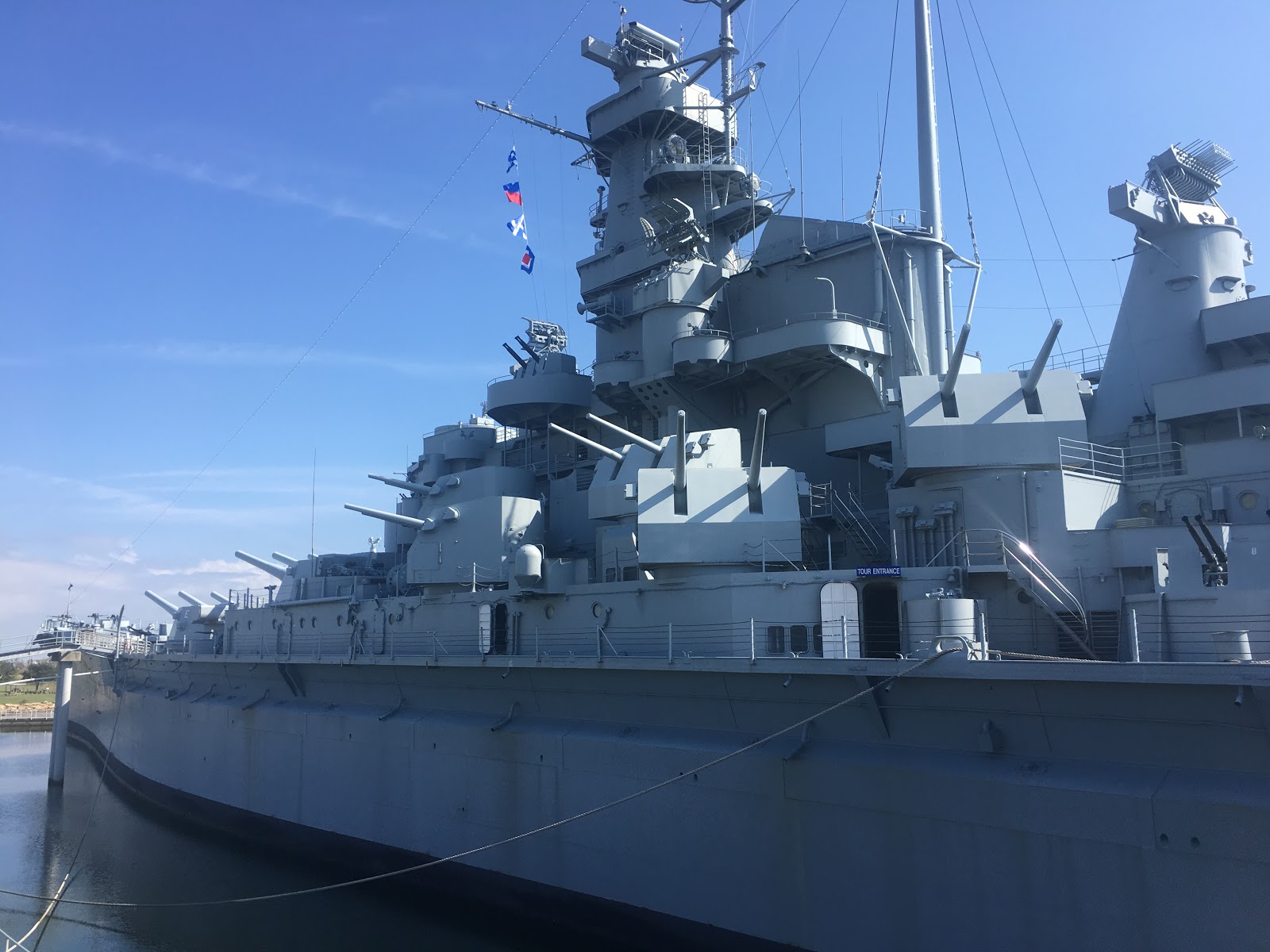
The USS Alabama.  

 We showered at the YMCA, two blocks away, and ate one meal each day in the fantastic restaurants on Dauphin Street.  Tops on our Mobile sightseeing list are the USS Alabama (the ship is as it was during WW II) and the Mobile Carnival Museum to better understand Mardi Gras, which actually started in Mobile, not New Orleans.  Neither Bill nor I had any understanding of the number of social societies and their members that spend hundreds of thousands on parade floats, balls, costumes and the annual coronation of a king and queen and their court.
Bill got to play a little
basketball at the YMCA.

Across from us at the Convention Center were two Navy
multihulls being built by Austal.  We were told that these
ships can travel at over 50 knots.
Just above us on the river was
the Mobile Port Authority dock.


The elaborate robes and dress of one king and queen.


Before we left the Convention Center, Dwight and Chris tied up
to the wall to wait out the tornado warning.  We all celebrated
finishing the rivers (Over 1,200 miles from Chicago!)
 as well as the tornado staying north of Mobile.
The morning we left Mobile seemed calm, but as we got out in the Bay, the waves increased to 3 feet or so on our beam. I was terrified, but Bill assured me that we were not in danger. It definitely takes some rethinking to go from calm rivers to sea waves. We need to remember to factor weather and wave conditions into our planning and wait for a “weather window”. This is much less important on the rivers. Anyway, the trip was fairly short and we made it safely to Fairhope on the eastern shore of Mobile Bay.   Fairhope was founded by disciples of economist Henry George, who advocated that land be held in common and made available to residents who paid a single tax.  Now, Fairhope is a fancy little town with 33 restaurants and many expensive gift and clothing stores.  Nice, but not a highlight for us.


Salty Paws at the Fairhope Municipal Pier.

Sunset at our last November anchorage.

We left Maine for this?
We then left Mobile Bay and entered the Gulf Intracoastal Waterway, on our way to Florida. After a beautiful and quiet night at anchor, where we were greeted by the first of many dolphins, we went east on the GICW to Orange Beach.  Here we will have our engines serviced and boat kept while we travel back to Maine. This has been a great place to hole up as the temps dropped to the 20s Wednesday (11/13) morning and the wind whipped ferociously. Thank you, shore power and heat!


Now, let's go home for a bit!