|
| Salty Paws is most always the smallest boat around, here on a mooring at the gorgeous Exuma Land and Sea Park. |
The Exumas are one of the world’s best and most beautiful
cruising grounds.
The color of the clear water is unbelievable and never fully captured in a photograph. These islands aren't quite perfect, though, and the blog will indicate why. But first, a little bit about the Exumas.
 |
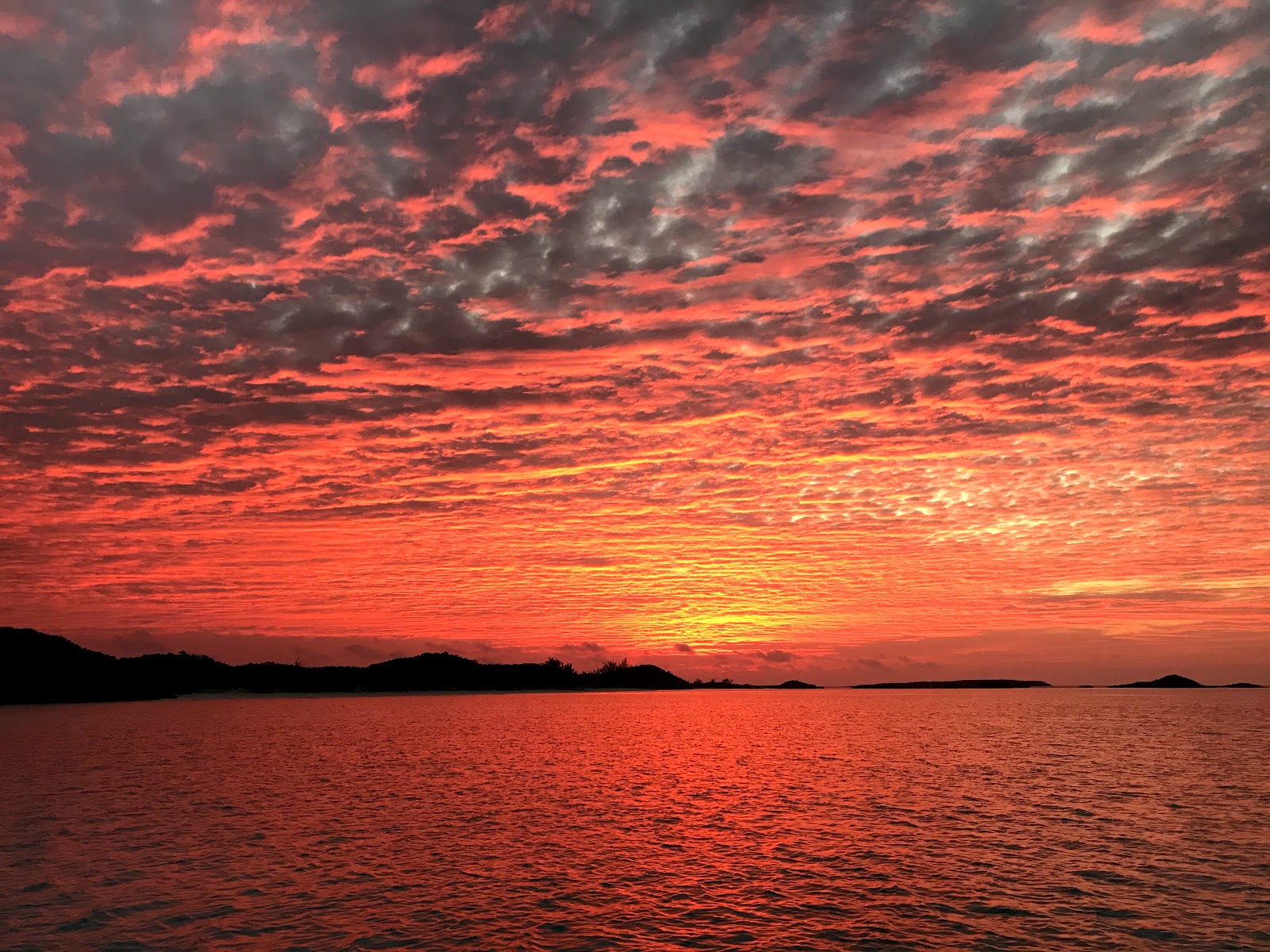
| One of the most beautiful sunrises that we have seen. The picture was taken in Norman's Pond on Norman's Cay. |
 |
Our friend Dietrich and I climbed to
the top of Bell's Rock, Cambridge Cay. |
Its 365 islands begin about 50 miles west of
Nassau and extend south and south east for over 120 miles.
The limestone islands are surrounded with
countless places to anchor in the sandy bottom next to one of the thousands of
white sand beaches and beautiful coral reefs for swimming, snorkeling and
diving
. Many cays have hiking trails, and the wildlife, while sometimes hard to find, is spectacular. Virtually every day there is a beautiful sunrise and sunset, and in our month in the Exumas we had, perhaps, only one hour to rain.
 |
We had many guests on our boat. Here
with Grant and Wendy from Vindaloo. |
 |
| The larger boats are the best for hosting. |
 |
We shared drinks with Dietrich and
Annie at MacDuffs, the one restaurant
on Norman's Cay. |
While cruising the Exumas we crossed paths and shared meals, snorkeling and hiking on multiple occasions with cousin Zeke and Hallie Holland on their boat Mikat as well as with
other cruisers who have become friends including Dietrich and Annie on Calliope, Steve and Pam on Morning Dew, Bill and Julie on Jubilee II, Grant and Wendy on Vindaloo and fellow Gold Loopers Chris and Catherine on Two Loons.
We even ran into Canadians David and Martine on Caribou, whom we had first met in the Bahamas in December 2016.
 |
With Zeke and Hallie at the plantation
ruins on Crab Cay near Georgetown. |
The islands were largely uninhabited until after the American Revolutionary War when the British Government encouraged loyalists to settle some of the Bahamian islands.
Whites, often with accompanying slaves, began settlements on cays (pronounced keys) like Little Farmers Cay that we visited.
Slavery was abolished by the British in 1833, long before the American Civil War. Roosevelt Nixon, proprietor of the Little Farmers Cay Yacht Club shared this picture of his ancestors, taken in 1911. It is easier to decipher in person but shows the white descendant sons of one loyalist, each with a black wife and their numerous offspring.
The island settlements grew but remained small, typically a few hundred residents.
Over time and today, young adults are increasingly pulled to the more available jobs in Nassau, now a metropolis of 600,000 people.
We met a number of Exuma islanders working in tourism while their spouse and children were in Nassau.
The Bahamian Government is apparently making efforts to encourage residents to remain on the islands, and the Little Farmers Cay School is well-equipped with computers and teachers for its 12 students.
Pregnant women are still encouraged to go to Nassau in their 28
th week in preparation for the upcoming birth in one of its modern hospitals.
Many choose to remain.
 |
The winds came up one day in Norman's Cay, reaching a high
of 35 knots that night. We ended up moving our boat during the
wee hours of the morning as we were too close to a sand bar. |
Now, the negatives. First the wind. It frequently blows 20 knots (roughly 25 mph) and more for days at a time. Accompanying such winds are waves of 6 feet or more. Most cruisers end up staying put in protected anchorages until the blow subsides, but between lack of patience and inaccurate weather forecasts, too often boats leave sooner than they should. Such was the case when we left Georgetown to begin returning north, which requires 15 miles of open water passage. The forecast was 10-15 knot south winds on our stern and waves 2-4 feet on our aft beam. Such conditions were doable, but very lumpy. Indeed, once outside the harbor, the trip was very uncomfortable. Turning around was a possibility but would be even more uncomfortable as we would be heading into the wind. Molly left the co-pilot seat and opted for the couch. I made a big mistake in not having her close and latch her port-side door before she moved.
I needed both hands for the wheel and speed control as waves were increasing in size. One large wave caught Salty Paws, pushing the boat to starboard and lowering the port side into the water (called a broach). As I struggled to get the boat back to port, water came rushing in through the open door and quickly flowed aft, flooding the cockpit with almost a foot of water. The boat quickly righted itself, and the water in a couple of minutes flowed back out the scuppers (open cockpit drains on the stern of the boat). We eventually arrived safely in the protected islands north of Georgetown. I had a restless night, reflecting on our mishap, and eventually got up around 2 am to write an Open Water Checklist to ensure that we would be better prepared for future offshore passages.
 |
| Our day of collecting plastic. |
 |
| Here is our pile! . |
The other negative is trash, specifically plastic that has washed up on otherwise idyllic beaches. We spent one whole day collecting roughly 400 pounds of plastic off one beach in the Park. We alerted the Park to the exact location and have the hope that it will be picked up before the next hurricane disburses it again. All of this has got us rethinking our use of plastic, and Molly is supporting 4Ocean, an organization devoted to cleaning up plastic from our oceans. Our hope is that it is not too late as microscopic bits of plastic are now being found in the bellies of fish and contributing to greater mortality.
We are forever thankful to have this cruising experience. Below are pictures that further detail our adventure.
 |
| Here is some of our collection off beaches (not in the Park, where it is prohibited). We used the conch shell to make a horn, and it is customary to blow a couch at sunset each night. |
 |
| Many of the islands throughout the Exumas are owned by celebrities. The magician David Copperfield owns one, and he commissioned the stainless still sculpture of a piano and listening mermaid, which he had submerged in 10 feet of water. Zeke and I dove down to tickle the ivories. |
 |
Some turtle researchers came by our boat to
show us the turtles they were tagging. Notice
the 70 pound turtle on the floor. Being upside
down makes the animal temporarily comatose. |
 |
| We kayaked multiple times to remote beaches. |
 |
| We chose not to go swimming here at Highbourne Cay. |
 |
| One of the 3-ft iguanas on Allen's Cay.. |
 |
| One of the beaches at Highbourne. |
 |
| Here Molly and Hallie are snorkeling at the popular diving spot call the Aquarium. |
 |
| Some of the many fish at the Aquarium. |
 |
| Annie found a geocache on Cambridge Cay, and we hid the container again after adding to the message for the next finder. |
 |
| The west side of Cambridge reminded us of Maine's Monhegan Island, but with very different rock. |
 |
| We anchored off Compass Cay and kayaked up the creek along with Zeke and Hallie (Dietrich and Annie walked) to one of the neatest features in the Exumas, Rachel's Bubble Bath. The crashing waves in the distance create a natural bubble bath. |
 |
| Rachel's Bubble Bath with Dietrich and Zeke about to be engulfed in the bubbles. |
 |
| We tied a rope to a rock so that we could hang on as the waves crashed above us. I am holding on as the wave breaks above me. |
 |
| The beach at Fowl's Cay includes the wreck of a plane that overflew the nearby private runway. The Exumas has a number of small plane wrecks, many now popular diving sites. |
 |
| I snorkeled to the entrance of the Thunderball Grotto and could look through to the other side. To Molly's delight, I decided not to try to snorkel through as I was alone. The grotto has been in two James Bond movies. |
 |
| A barracuda stayed most of the day under our boat while at anchor in Staniel Cay. |
 |
| We enjoyed a wonderful anniversary lunch at the Staniel Cay Yacht Club. Our waitress commutes 7 miles each way in an open boat from Black Point. She returns to Nassau twice a month to see her husband and daughter. |
 |
Here I looks in charge but once the race started,
I was just weight.. |
 |
We arrived in the Black Pt. Settlement in time
for the race. |
 |
| Finally, we are under sail in the traditional Bahamian Class C sail boat. Racing regettas are common in the islands. |
 |
| Molly took this great shot of the two sail boats passing on opposite side of Salty Paws. Note the board used for crew to hike out on to counter the force of the wind. Coming about is very interesting as the board has to be moved to the other side. |
 |
| One of the pretty spots on Great Guana Cay near Black Point. |
 |
| This is the Blow Hole on Great Guana that only operates at a high tide with sufficient surf. |
 |
| My shooting percentage rivaled Tacko Fall's. |
 |
| They still exist but are on the last legs! |